Buy speechtherapist.eu ?
We are moving the project
speechtherapist.eu .
Are you interested in purchasing the domain
speechtherapist.eu ?
domain@kv-gmbh.de · 0541-91531010
Buy speechtherapist.eu ?
What is the pronunciation in Spanish?
The pronunciation in Spanish is generally phonetic, meaning that words are pronounced as they are spelled. Each letter has a consistent sound, with few exceptions. Vowels are pronounced clearly and consistently, and there are specific rules for stress and accent marks. Overall, Spanish pronunciation is relatively straightforward once the basic rules are understood. **
Was the Spanish pronunciation influenced by Arabic?
Yes, the Spanish pronunciation was influenced by Arabic due to the centuries-long presence of Arabic-speaking Muslims in the Iberian Peninsula during the medieval period. This influence is particularly evident in the pronunciation of certain consonants and vowels in Spanish, as well as in the rhythm and intonation of the language. Additionally, many words of Arabic origin were incorporated into the Spanish vocabulary, further contributing to the linguistic influence of Arabic on Spanish pronunciation. **


Similar search terms for Spanish
Top-Angebote
Products related to Spanish:
-
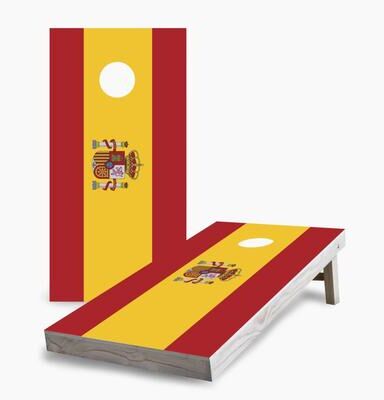
Skip's Garage Spanish Flag Cornhole Boards"Includes: (2) Cornhole Boards & (8) Bags. Boards are Regulation Sized 24"" Wide x 48"" Long. Bags Will Complement The Board Colors. Easily Message Us Bag Color Requests. Easily Add a Carry Cases, Lights, or Both!"341,99 $*Shipping: 0,00 $Secure redirect to the provider
-
English-Spanish Buddy Readers: SET 1Young learners will love these funny, easy-to-read little books with text in both English and Spanish. These simple stories feature high-frequency words, rhyming, repetition, and adorable illustrations on topics kids love. Perfect as a bilingual...20,39 $*Shipping: 0,00 $Secure redirect to the provider
-
English-Spanish Buddy Readers: SET 2Young learners will love these funny, easy-to-read little books with text in both English and Spanish. These simple stories feature high-frequency words, rhyming, and adorable illustrations on topics that kids love. Perfect as a bilingual resource...20,39 $*Shipping: 0,00 $Secure redirect to the provider



-
What is the pronunciation like in Spanish?
The pronunciation in Spanish is generally phonetic, meaning that words are pronounced as they are spelled. Each letter typically has a consistent sound, making it easier for learners to understand and pronounce words. Spanish also has a rhythmic and melodic quality, with a clear emphasis on certain syllables in words. Additionally, the language has a relatively small number of vowel and consonant sounds, making it simpler for non-native speakers to master the pronunciation. **
-
How can one imitate the Spanish accent?
To imitate the Spanish accent, one can start by listening to native Spanish speakers and paying attention to the way they pronounce certain sounds and words. It's important to practice rolling the "r" sound and pronouncing vowels with a clear and open sound. Additionally, focusing on the rhythm and intonation of the language can help in imitating the Spanish accent. Finally, practicing speaking Spanish regularly with native speakers or language partners can also help in improving one's accent. **
-
Is the Spanish and Dutch accent similar?
The Spanish and Dutch accents are quite different from each other. Spanish is a Romance language with a melodic and rhythmic accent, while Dutch is a Germanic language with a more guttural and clipped accent. The pronunciation of vowels and consonants also differs between the two languages, leading to distinct accents. Overall, the Spanish and Dutch accents are not similar. **
-
Is Spanish the world language?
Spanish is not considered the world language, as that title is often given to English due to its widespread use in international communication, business, and diplomacy. However, Spanish is one of the most widely spoken languages in the world, with over 460 million native speakers. It is an official language in 21 countries and is commonly used as a second language in many others. **

Which language, Spanish or English?
It depends on the context and the specific needs of the situation. Spanish is the second most spoken language in the world and is widely used in many countries, especially in Latin America. English, on the other hand, is the most widely spoken language globally and is often used as a common language for international communication. Both languages have their own advantages and it's important to consider the specific requirements of the situation when choosing which language to use. **
Which language, Greek or Spanish?
It depends on the context and purpose. If you are interested in learning a language with a rich history and influence on Western culture, Greek would be a great choice. However, if you are looking for a widely spoken language with practical applications in many countries, Spanish would be a better option. Ultimately, the decision should be based on your personal interests and goals. **
Top-Angebote
Products related to Spanish:
-
Gaslow Euro/Spanish AdaptorThe Euro/Spanish Fill Adapter allows you to fill at European LPG stations with the Euro/Spanish style pump nozzle. The adapter simply screws into the internal thread on the UK Fill point. Suitable for pumps in Spain and Germany.22,56 £*Shipping: 5,00 £Secure redirect to the provider
-
Learn Spanish with the Michel Thomas Method – Foundation Spanish New Edition Beginner Audio CourseFoundation Spanish New Edition - Learn Spanish with the Michel Thomas Method Description Looking for a convenient language course that fits your lifestyle and gets you speaking a new language in a matter of weeks; not years? The original no-books; no-homework; no-memorizing method is in tune with the way the brain prefers to receive; store and retrieve information. You'll stick with it because you'll love it. * Pick up Spanish naturally and unforgettably without strain or stress * Learn from listening and speaking; without the pressure of writing or memorizing * Build up your Spanish in manageable steps by thinking out answers for yourself WHY IS THE METHOD SO SUCCESSFUL? 'What you understand; you know; and what you know; you don't forget.' - Michel Thomas Before there was machine learning; there was Michel Thomas. For over 50 years he worked on decoding languages by breaking them down into their most essential component parts. These 'building blocks' are introduced to the learner sequentially in such a way that you reconstruct the language for yourself - to form your own sentences; to say what you want; when you want. This unique method draws on the principles of instructional psychology and works with the way your brain prefers to receive; store and retrieve information. Knowledge is structured and organized so that you absorb the language easily and don't forget it. The method is designed to eliminate the stress which prevents you from relaxing and allowing the brain to work in the way which accepts learning in a seemingly painless; very exciting and highly motivating way. HOW DO THE COURSES WORK? 'All stress inhibits true and effective learning' - Michel Thomas During the course; you will join Michel Thomas and two students in a live lesson; learning from both their successes and their mistakes to keep you motivated and involved throughout the course. You; as the learner; become the third student and participate actively in the class. Within the very first hour you will be able to construct simple phrases by listening and thinking out answers for yourself without the pressure of writing or stress of having to memorize. You will learn at your own pace; pausing and repeating where necessary; and complete the course in about 20-30 hours. By the end of the course; you will understand and have the confidence to speak basic Spanish. WHAT WILL I ACTUALLY ACHIEVE? 'I am the architect who builds the house. It's up to you to decorate it.' - Michel Thomas The Michel Thomas Method will help you kick-start; continue; and flourish in your Spanish language learning journey. It is not intended to get you perfectly fluent; but it will get you speaking and using Spanish; with proper pronunciation; faster than most any other method. It is designed to give you a strong foundation and good working knowledge of a language from which you can expand and later 'add decoration' to. It is a rapid method for learning; but still requires effort and concentration on the...20,99 £*Shipping: 2,99 £Secure redirect to the provider
-
Skip's Garage Spanish Flag Cornhole Boards"Includes: (2) Cornhole Boards & (8) Bags. Boards are Regulation Sized 24"" Wide x 48"" Long. Bags Will Complement The Board Colors. Easily Message Us Bag Color Requests. Easily Add a Carry Cases, Lights, or Both!"341,99 $*Shipping: 0,00 $Secure redirect to the provider
-
What is the pronunciation in Spanish?
The pronunciation in Spanish is generally phonetic, meaning that words are pronounced as they are spelled. Each letter has a consistent sound, with few exceptions. Vowels are pronounced clearly and consistently, and there are specific rules for stress and accent marks. Overall, Spanish pronunciation is relatively straightforward once the basic rules are understood. **
-
Was the Spanish pronunciation influenced by Arabic?
Yes, the Spanish pronunciation was influenced by Arabic due to the centuries-long presence of Arabic-speaking Muslims in the Iberian Peninsula during the medieval period. This influence is particularly evident in the pronunciation of certain consonants and vowels in Spanish, as well as in the rhythm and intonation of the language. Additionally, many words of Arabic origin were incorporated into the Spanish vocabulary, further contributing to the linguistic influence of Arabic on Spanish pronunciation. **
-
What is the pronunciation like in Spanish?
The pronunciation in Spanish is generally phonetic, meaning that words are pronounced as they are spelled. Each letter typically has a consistent sound, making it easier for learners to understand and pronounce words. Spanish also has a rhythmic and melodic quality, with a clear emphasis on certain syllables in words. Additionally, the language has a relatively small number of vowel and consonant sounds, making it simpler for non-native speakers to master the pronunciation. **
-
How can one imitate the Spanish accent?
To imitate the Spanish accent, one can start by listening to native Spanish speakers and paying attention to the way they pronounce certain sounds and words. It's important to practice rolling the "r" sound and pronouncing vowels with a clear and open sound. Additionally, focusing on the rhythm and intonation of the language can help in imitating the Spanish accent. Finally, practicing speaking Spanish regularly with native speakers or language partners can also help in improving one's accent. **
Similar search terms for Spanish
-
English-Spanish Buddy Readers: SET 1Young learners will love these funny, easy-to-read little books with text in both English and Spanish. These simple stories feature high-frequency words, rhyming, repetition, and adorable illustrations on topics kids love. Perfect as a bilingual...20,39 $*Shipping: 0,00 $Secure redirect to the provider
-
English-Spanish Buddy Readers: SET 2Young learners will love these funny, easy-to-read little books with text in both English and Spanish. These simple stories feature high-frequency words, rhyming, and adorable illustrations on topics that kids love. Perfect as a bilingual resource...20,39 $*Shipping: 0,00 $Secure redirect to the provider
-
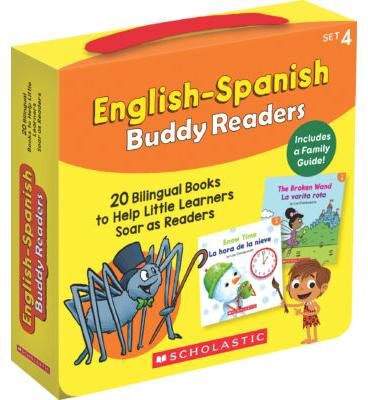
English-Spanish Buddy Readers: SET 4Young learners will love these funny, easy-to-read little books with text in both English and Spanish. These simple stories feature high-frequency words, rhyming, repetition, and adorable illustrations on topics that kids love. Perfect as a...20,39 $*Shipping: 0,00 $Secure redirect to the provider
-
English-Spanish Buddy Readers: SET 3Young learners will love these funny, easy-to-read little books with text in both English and Spanish. These simple stories feature high-frequency words, rhyming, and adorable illustrations on topics that kids love. Perfect as a bilingual resource...20,39 $*Shipping: 0,00 $Secure redirect to the provider
-
Is the Spanish and Dutch accent similar?
The Spanish and Dutch accents are quite different from each other. Spanish is a Romance language with a melodic and rhythmic accent, while Dutch is a Germanic language with a more guttural and clipped accent. The pronunciation of vowels and consonants also differs between the two languages, leading to distinct accents. Overall, the Spanish and Dutch accents are not similar. **
-
Is Spanish the world language?
Spanish is not considered the world language, as that title is often given to English due to its widespread use in international communication, business, and diplomacy. However, Spanish is one of the most widely spoken languages in the world, with over 460 million native speakers. It is an official language in 21 countries and is commonly used as a second language in many others. **
-
Which language, Spanish or English?
It depends on the context and the specific needs of the situation. Spanish is the second most spoken language in the world and is widely used in many countries, especially in Latin America. English, on the other hand, is the most widely spoken language globally and is often used as a common language for international communication. Both languages have their own advantages and it's important to consider the specific requirements of the situation when choosing which language to use. **
-
Which language, Greek or Spanish?
It depends on the context and purpose. If you are interested in learning a language with a rich history and influence on Western culture, Greek would be a great choice. However, if you are looking for a widely spoken language with practical applications in many countries, Spanish would be a better option. Ultimately, the decision should be based on your personal interests and goals. **
* All prices are inclusive of VAT and, if applicable, plus shipping costs. The offer information is based on the details provided by the respective shop and is updated through automated processes. Real-time updates do not occur, so deviations can occur in individual cases. ** Note: Parts of this content were created by AI.